Showing posts with label Art. Show all posts

Mar 8, 2010


Peter Blake, The Letter "E", 2007
Silkscreen, embossing and glaze on somerset satin 300gsm
52 x 37.5 cm, signed and numbered, Edition of 60

Jan 11, 2010


Tauba Auerbach, E, 2005, Ink on paper, 50 x 38 inches

Jan 4, 2010

Jackson Pollock - Guggenheim Application (1947)


Jackson Pollock, Mural, 1943
Oil on canvas, 8 feet 1.25 inches x 19 feet 10 inches
University of lowa Museum of Art


I was wondering if Pollock was name dropping in his application...

"I intend to paint large movable pictures which will function between the easel and mural. I have set a precedent in this genre in a large painting for Miss Peggy Guggenheim which was installed in her house and was later shown in the "Large-Scale Paintings" show at the Museum of Modern Art. It is at present on loan at Yale University.

I believe the easel picture to be a dying form, and the tendency of modern feeling is towards the wall picture or mural. I believe the time is not yet ripe for a full transition from easel to mural. The pictures I contemplate painting would constitute a halfway state, and an attempt to point out the direction of the future, without arriving there completely."

Alas, that year Pollock did not receive the Guggenheim Fellowship.


Dec 26, 2009

Perpetual Inventory by Rosalind Krauss


Robert Rauschenberg, Renascence, 1962.
Oil and silkscreen on canvas, 36 by 36 inches (91.4 x 91.4 cm).
"Random Order." Location 1, no. 1 (Spring 1963), p. 30.


What I culled from:

Perpetual Inventory by Rosalind Krauss
October 88, Spring 1999, pp. 87-116.

An interesting read regarding Robert Rauschenberg, the psychologizing of the artist's means, his work after the early Combines and the Random Order project and the introduction of photography into his oeuvre.

As for trying to eliminate the psychological from the work, his example of the "sad cup of coffee" resonated:
Speaking of the talk at the Cedar Bar of the Club, he complained, "They even assigned seriousness to certain colors," and then, turning to the way the New York artists had infected Beat poetry: "I used to think of that line in Allen Ginsberg's Howl, about 'the sad cup of coffee.' I've had cold coffee and hot coffee, good coffee and lousy coffee, but I've never had a sad cup of coffee."
To refrain from describing something in such a Freudian way is compelling, but alas, he is misunderstood when his Black Paintings are read as somber and, for that matter, sad.

Random Order is seen by Krauss as a shift by Rauschenberg to a new relationship to the 'integrity of the picture plane':
Rauschenberg seems to have wanted the continuity of the mirrorlike photographic surface to stamp its character on his newly revised sense of his medium, thereby replacing the collage condition of his Combines with the seamlessness of the photographic print.
It is here that the illusionary picture plane of Renaissance painting and the "mirrorlike" photo-based image combine. A point is made by Krauss about the conflation of the indexical and the iconical in the work. Rauschenberg says, "A dirty or foggy window makes what is outside appear to be projected on to the window plane." It is interesting for me to think of his earlier works - the black monochromes that attempted unsuccessfully to be devoid of psychological effect to his white works that function as a screen upon which the trace of a referent leaves its temporary 'mark' - and to see how they relate to the photo-based work that followed.

Krauss speaks about Rauschenberg's "connections between shadow and photography, on the one hand, and index and silence on the other" and, through this, his relationship to Barthes and semiotic analysis. Rauschenberg's success at the 1964 Venice Biennale comes at the same time as the discussion of the concurrent work being done by Warhol. Both (or all three, if you count Barthes) are deeply interested in the use of the photomechanical method to produce work. Krauss says, "the media saturation of daily life had made the ubiquity of the photographic a subject of some urgency, whether for theory or for making art." Then much more is said about Rauschenberg and his relationship to language; that of the Surrealists, specifically, Breton and the work of Dante, which he illustrated. I found this section of Krauss's essay to be of least interest to me, but it definitely informs Krauss's post-medium thoughts and her thoughts about the use of language in art in her future work.

The relationship of Rauschenberg and Robert Frank is brought up - the use of the veil and/or screen in both of their photography is pointed out. Rauschenberg builds an archive from the images he takes and the images he "scours" from media sources. Some of these images are interspersed through Random Order. And then, the Atlas, begun in 1962, by Gerhard Richter is introduced to the essay. The Atlas was for me quite influential and to learn of Ritcher's first opportunity to see Rauscheberg's work in the 1959 exhibition Documenta II: Kunst nach 1945 was particularly interesting. The parallels of the careers of Richter and Rauscenberg, two of my earlier influences, is of note. It was in 1962 that Rauschenberg embarked on a similar series in his use of the photograph, its serialization, the use of the grid, etc. I had never specifically pondered these parallels but taking them into consideration will continue to inform my thoughts about the use of the archive in contemporary art.


Matt Lipps, Untitled (bar), 2008.
C-print on aluminum, edition of 5 + 2 AP, 48 x 35 inches.


I was thinking of Matt Lipps's work at some point while reading this essay. Something Krauss said was, "Rauschenberg's handling of photography would give us the sense of our connection to a place that is only possible through the intensity of our experience of separation from it, the sense that to see it directly is so painful that the image must somehow be mediated by the presence of a veil". In his newer work, Home Series, the artist uses images from his mother's home. They are photographed, printed, cut out, collaged and re-photographed. There are screens of color, as well as shadows (created by the collaged images of Ansel Adams's landscapes inserted into the space of the 'rooms'). The physical location of both the artist's mother's home and the landscape are conflated, but the artist is clearly operating within the psychological space of the home. Does the freedom of the 'natural' landscape offer release from the confines of the home? Does it function as a veil of that which happens in the home? I am going to finish with these questions, but it is something that I will continue to think about as I include Matt's work in the A3x10 project.

More to come in 2010.

Oct 4, 2009

Visceral Realists at Federal Art Project

I just saw a show called The Search for the Visceral Realists , Curated by York Chang, in collaboration with Federal Art Project and Pink Cloud Event at Federal Art Project this Saturday.

The show was tightly curated with enough information for someone who may be new to the work of the Visceral Realist to quickly grasp the huge prescient influence they had on the art world. To disrupt a system while being within that same system is one of the most subversive acts that I can imagine.

I was very impressed by the presentation of the original material. Nicely done.

The Search for the Visceral Realists: Exhibition Trailer from Alfonso Delgado on Vimeo.

Sep 13, 2009


Thomas Eggerer, Red E, 2006, oil on linen, 38.98 x 34.25 inches

Oct 9, 2008

Artwork

Untitled (23 September - Ramon Emeterio Betances, Segundo Ruiz Belvis, Filiberto Ojeda Rios), 2005-8

C-print, unique, 48 x 32 inches each

On the anniversary of El Grito de Lares (which, led by Ramon Emeterio Betances and Segundo Ruiz Belvis, attacked the exploitation of the Puerto Ricans by the Spanish colonial system and called for insurrection in 1868), Filiberto Ojeda Rios was killed by FBI agents. Some groups are framing the death as the unwarranted assassination of a key player in Puerto Rico's anti-U.S. colonialism movement. This work speaks to the cyclical (Spanish colonialism vs. U.S. colonialism) and arbitrary nature of history and historical dates.


Click on images to enlarge them as they are intentionally blurred:


Tunnels

When I was in Montenegro, we traveled through the Sozina (Созина) tunnel from Podgorica to Bar on one of our excursions. The tunnel was placed into service on July 13, 2005 (incidentally, my birthday). The tunnel is 4,189 m long, and is the longest and most modern vehicular tunnel in Montenegro. I found the tunnel to be a symbol of the progress of the nation as well as a psychological referent to the 'birth of the nation.' This has started an interest in the mythology of tunnels and their place within the human psyche. This is from an interpretation of dreams about tunnels:

While I am not much of a subscriber to notions Fruedian and/or Jungian, I still enjoy entertaining the idea of pseudoscience (in dream and subconscious interpretation) as being relevant to our understanding of the world. In other words, whether or not there is 'truth' to the meaning of, say, tunnels, we attribute meaning to them through our construction of mythologies surrounding them.

Here are you nice images of the modern tunnel; well-lit, clean, futuristic, yellow and full of richness and meaning:


Image for Upcoming Artwork


I have been working through some ideas regarding Kosovo and Serbia vis s vis the US-born Olympian Milorad Čavić. Above is an image of him holding the Serbian flag and text regarding the act follows.


Cavic endeared himself to Serbs in March when he was suspended from the European Championships for wearing a T-shirt proclaiming "Kosovo is Serbia"—a reference to Kosovo's controversial declaration of independence from Serbia on Feb. 17.

After returning home from that meet, Cavic was greeted by hundreds of fans and met with Serbian nationalist Prime Minister Vojislav Kostunica, who called the swimmer a "hero."

At the Euros, Cavic made his political statement on the podium after winning the 50 fly, displaying a red T-shirt with text in Cyrillic. The European swimming federation ruled the message a political slogan and ejected him— knocking him out of his remaining two events.

"I had to help my people knowing it could be a big risk for my swimming career. I'm proud of what I did," Cavic said then. "I had to do it to help the (Kosovo Serbs), knowing how hard it is for them there."

Cavic became an inspiration among Serbs who object to losing Kosovo, an ethnic Albanian-dominated territory which many Serbs consider the historic cradle of their nation.

Kosovo's independence has been recognized by the United States and most European Union nations.

Cavic, who was born in Anaheim, Calif., to Serb parents and trains in Florida, said he was just trying to send "positive energy" to the country he represents.

Oct 30, 2007

Kelly Nipper at Anna Helwing Gallery


I went to the Kelly Nipper exhibition at Anna Helwing Gallery before it recently came down. I enter the darkened space through drapes over the back gallery glass wall. On the left and right entry were a series of six photographs of mechanically produced choreography diagrams. While the choreography is based on the work of dance artist and theoretician Rudolf Laban from the early 20th century, as a photographic work, these images served to freeze frame the performative nature of the video I was about to witness. They seem cursorily produced from vast and important research for the work, but are still a good addition to the show. I also appreciated the connection between the photograph serving as a still-frame from a cinematic production based on a performance.

Within the main space were two seemingly identical video projections on opposite walls from each other. A dancer standing in front of a black wall performed a slow circular hip rotation in a black leotard. The leotard blended with the black wall resulting in the image of a decapitated head and bear arms motionlessly floating above her pale gyrating hips. Upon, closer inspection one notices that the movement is faster in one of the two videos and the seriality of the project is cracked.

Sarah Lehrer-Graiwer has written about the video on her Artforum Pick, so I will move to the sound booth sculpture…

Also, in the main space, but snaking its way toward an alcove behind one of the video walls, was a sound recording booth. A brilliant sculpture in minimalist tradition, the approximately five-foot square booth was open on one side to reveal a low platform covered in Mylar used for drum heads resting below a mobile made of wire and oval ice. As the ice slowly melted, an amplifying system connected to speakers in the alcove broadcasted thunderously loud thumps recorded by microphones under the platform.

My knowledge of the basis of Nipper’s decisions is vague, but reading the press release introduces the thought of “the hurricane as a form of unmeasured movement presented in relation to clock-time, human emotion, and the science of meteorology.” As storms generate precipitation higher in the atmosphere as ice that melts and falls as rain, the conceptual force of the sculpture is the most cogently strong thing I’ve experienced in art this year. Brava to Kelly Nipper for her outstanding performance.

I understand the work will be re-installed at ArtBasel Miami Beach this December. I highly recommend it there as this work will probably next be seen in a museum or (unfortunately) tucked away in a collector’s vault or private home.

Sep 23, 2007

Lari Pittman at Regen Projects


I went to the Lari Pittman opening last week. I was introduced to his work when I was at the Art Institute of Chicago about 10 years ago. I was, at the time, skeptical. I was interested in signs (the literal and the figurative) and I thought he was a very good painter, but I never got as excited as many did. I guess one needs to spend more time deciphering the works than I was wanting to invest back then.

The new works are much more interesting to me than the older works were. They seem deeper and definitely more complex. There is also an element to the work that I attribute to the "personal." Having been in the program at Otis and knowing his partner, Roy, and knowing Roy's work and knowing a bit about the objects they collect, I feel I have a bit more access to the work now.

But, then there are very specific subjects in the work that are fascinating: Cacti, fruit, overgrowth, vines, body parts, eggs, lamps, shafts of light. There seems to be a more specific era evoked in the work as well. There is an idea of traditional Americanism that looks toward "bounty" as a sign, but then there is also presented the reality of cultural diversity and the abjectness of this excess. The conflation of various technical depictions adds to this read for me. Woodblock, carvings, patterns and color schemes (could these be viewed as Latin American, as well?).

A quote from the press release doesn't give much narrative explanation but does talk nicely about the dichotomies that exist in the work:

In these new works, a rough, dark, and unsettled undercurrent is present. A formal and conceptual tension exists – an antithetical dynamic structured by the co-existence of numerous dichotomies. This simultaneity of opposites is illustrated in the themes found within the works: somber/celebratory, death/life, beautiful/ugly, utopic/dystopic, sublime/profane, radiant/contaminated. Formally, Pittman's paintings are also structured by dichotomies – abstraction/figuration, personal imagery/broad cultural signs, reality/illusion. Within this play of opposites, a tension is created that draws the viewer in and invites them to explore the event unfolding before them.

Be sure to check it out soon. The show closes October 20th.

Oct 26, 2006

Old drawings


I came across these older drawings (probably did them last year) while cleaning up my harddrive. These are similar to the ones I posted last month in the use of basic office supplies and the balance between representation and abstraction. Images from left to right are: 1) A drawing of the wine shop from the desk at which I sat. 2) A drawing of a business card from a wine rep. 3) A phone message turned into a drawing. 4) A line drawing using various office supplies. 5) A U.O.ME/"Deathstar"esque abstract drawing. 6) A drawing of a missle fired from a silo. These were about 9" x 4" each.

I am back at work on new drawings and will post soon.

Sep 15, 2006

Call for Artists


The Universal Symbol for Emptiness
a group exhibition curated by Calvin Phelps
fall 2006

If emptiness can be defined as “an experience of being without, of not having,” then we have all, in our lives, experienced a form of emptiness. It is arguably a presupposed position starting from our birth and a state that we attempt to fill with experience throughout our lives. The state of emptiness is a point of beginning in both Eastern thought and Christianity, and can be seen alternatively as the ideal point of spaciousness and freedom or the point of crisis, deficiency and oppressiveness.

In psychoanalysis, C.G. Jung’s concept of the collective unconscious refers to the part of a person’s unconscious that is common to all people. Jung theorized that particular symbolic subject matter do exist across all cultures, through all time, and in every person. Is emptiness an unconscious part of us that can have a representative archetype? If so, what is it and how can it be depicted?

This exhibition tries to answer these questions, while raising more provocative ones. The work in this exhibition does not simply evoke the personal-psychoanalytical artists’ response to trauma or loss, but looks at the various forms the void of emptiness can and does take.

Please submit images of works for consideration for this exhibition to Calvin Phelps, 411 S Main St #413, Los Angeles, CA 90013 or email mail@calvinphelps.com.

______________________________________________________


Carl Jung is buried in a family grave at the Protestant Church Graveyard in Kusnacht. The gravestone is rectangular about five feet in height, bearing the arms of the Jung family, and beneath this the names of father, mother, sister Gertrud, wife Emma Jung-Rauschenbach, and C.G. Jung. The top and bottom borders repeat in Latin the motto he choose for his house Vocatus atque non vocatus deus aderit (Called or not called, God will be present). The right and left sides contain a passage in Latin from St. Paul's First Epistle to the Corinthians (1 Cor. 15:47) Primus homo de terra terrenus. Esecundus homo de caelo caelestis (The first man is of the earth and is earthly. The second man is of heaven and is heavenly).

Jul 10, 2006

New Drawings

I did these drawings today. They work as a suite of five images arranged in this order...


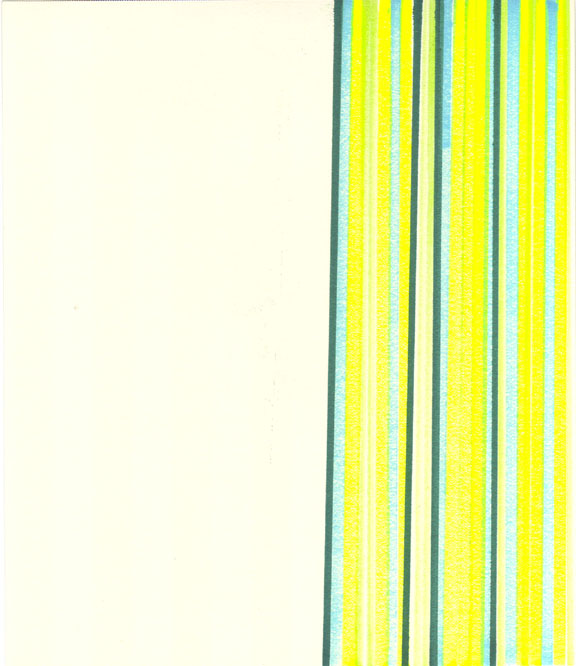
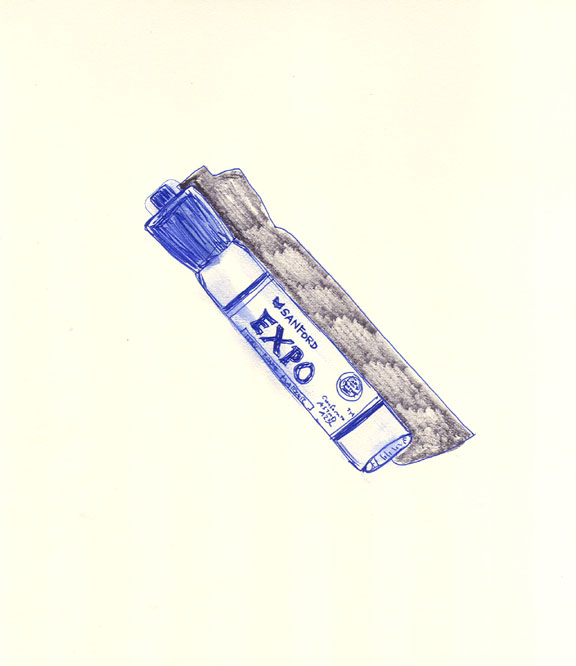
Details of each image follow. Each image is 9.25 by 8 inches. The first, third and fifth drawings are collages using newspaper images with Scotch tape and black Sharpie and Dry Erase Marker. Image two and three are drawings using various pens, markers and highlighters. Click on any image to get a closer look.

An image of a soldier with a baseball on a baseball filed.


A drawing made using highlighters and a Sharpie.


An image of Mexican politicans in front of a political poster.


An drawing of a dry eraser marker with shadow.


An image of a woman crying in the arms of a Salvation Army volunteer in London after the 7/7 attacks.

Jan 6, 2006

Jacques Derrida - The Gift of Death


The Gift of Death by Jacques Derrida


So, I have been reading this late work by Jacques Derrida recently. It was recommended to me by Joan whom I studied with at Otis. She said it was the best work by him. I wasn't sure what to expect, but decided to give it a go.


This book is amazing. Here is what Publishers Weekly has to say...


French philosopher Derrida stares death in the face in this dense but rewarding inquiry. Beginning with an analysis of an essay on the sacred by Czech philosopher/human rights activist Jan Patocka, Derrida follows the development of moral and ethical responsibility, and the concept of the soul's immortality, in the transition from Platonism to Christianity. He then ponders the self's anticipation of death in sacrifice, war, orgiastic mystery cults, murder and execution, with reference to Kierkegaard's Fear and Trembling, Nietzsche, Heidegger's thought (a "constant attempt to separate itself from Christianity") and the biblical story of Abraham's contemplated sacrifice of his son, Isaac, at God's behest. In the most provocative section, Derrida links religious injunctions of sacrifice to the "monotonous complacency" of modern society, which allows tens of millions of children to die of hunger and disease.


I admit that Chapters One (Secrets of European Responsibility) and Two (Beyond: Giving for the Taking, Teaching and Learning to Give, Death) were fairly easy to read and quite enthralling. Concepts dealing with responsibility and European heritage are fully detailed from the originary Heretical Essays in the Philosophy of History by Jan Patočka. But, Chapter Three (Whom to Give to: (Knowing not to Know)) was a stunner. After four rereadings Derrida's subtle deconstruction started to become clearer. It helps to hold two opposing views in mind simultaneously. As for the final Chapter (Tout autre est tout autre), I think ten more readings of it will help. I'll get back to you on how it goes.

In the meanwhile, here is a fantastic essay by Ivan Chvatík titled The Heretical Conception of the European Heritage in the Late Essays of Jan Patočka. Here is Chvatík's abstract of the essay:

In this short piece I am not undertaking to give a full discussion of the whole of Patočka’s ‘heretical’ work. I wish only make clear its most essential core. What, in Patočka’s view, made Europe Europe and what is Europe’s bequest to the world after what Patočka describes as its fall, completed by the two world wars? What should Europe look to conserve in itself if—as seems likely—it would like to once again play a respected role in world events? Is there something which the globalised world should take over from old Europe, or something which it should eschew, if it does not wish history to end and utter decadence to ensue?